San Mateo County Genealogical Society's Blog featuring society events, projects, meeting notes and other items of relevance to genealogists.

Sunday, July 22, 2012

Digging for Roots Online


By Dennis L. Maness, MLS
   
Call me old-fashioned but I love books! But I also love computers and what they can do, especially on the Internet. And, as I’m sure all of you do, I love genealogy. Wouldn’t it be nice if we could combine all three of these loves? Well, that’s what this post is about—genealogy books on the Internet!

There are books all over the Internet (a Google search for “~genealogy books online” gave me 3,800,000 results!) but for our purposes we’ll discuss the Big Three--Google Books, FamilySearch, and The Internet Archive.

Google Books
Go to https://www.google.com/  click on “More” and then click on “Books”.


There is a YouTube video (of course!) on what Google Books is and a bit on how to use it at http://youtu.be/9DGQO5Kp2og

Quick Search Tip—On Google the use of the tilde “~” (it’s on the top of the upper left key on my keyboard) means that the search will include synonyms of the word you’re searching for. For instance “~genealogy” will include the words “family history”, “family tree” “vital records” “genealogical” “surname” and probably many more in your search.

But I digress:
What kind of genealogical books can you find on Google Search?

There are vital records--

and individual genealogies,

family genealogies--


classic genealogical studies--


county histories--


historical works that may give you more insight into your ancestor’s lives—


and

And even genealogy themed novels!


=======================

FamilySearch Books

The last time I was at the Family History Library in Salt Lake City I went to look for a family history book on one of my family lines. When I got to the place where it should have been I found rows and rows of shelves that were empty! When I asked the staff what was going on they said that the books had been taken to be digitized, so that is why this site is so important for online users. I may be wrong but I think they said that the books would not be coming back for public display but would be kept in some underground or offsite storage.

Here’s how to read them: 
Go to https://familysearch.org click on “Books” (near the top), then click on the “Family History Books” link.


Below the search form there is a good description of this site:

Family History Books is a collection of more than 40,000 digitized genealogy and family history publications from the archives of some of the most important family history libraries in the world. The collection includes family histories, county and local histories, genealogy magazines and how-to books, gazetteers, and medieval histories and pedigrees. The valuable resources included in Family History Books come from the following partner institutions:
§ Allen County Public Library
§  Brigham Young University Harold B. Lee Library 
§  Brigham Young University Hawaii Joseph F. Smith Library
§  Church History Library 
§  Family History Library  
§  Houston Public Library - Clayton Library Center for Genealogical Research
§  Mid-Continent Public Library - Midwest Genealogy Center 


There’s not much more that needs to be said about this wonderful jewel of genealogy knowledge. There is, however, one warning you need to know—when you do a search for a title or subject the site will download the entire book as a PDF file before you can begin to read it. This is sometimes a lengthy process with large books. But worth it.

========================

The Internet Archive


Go to http://archive.org/, and click on the word “Texts” at the top.

You can search for pretty much the same kinds of books as I listed in the Google Books description.
In addition they have the [non-indexed] entire run of the U. S. Census. But again a warning—the interface is really ugly and often confusing but worth it when you find something that isn’t anywhere else on the Internet.

======================

There are many other sites that offer books. You might consider using Heritage Quest and Ancestry.com at your local library if you don’t have a subscription.

Sidenote: Here are two descriptions of the difference between the home subscription of Ancestry.com and the Library Edition:
http://proquest.com/assets/downloads/products/ale_ancestcom_comparison.pdf
http://blog.familytreemagazine.com/insider/2009/03/23/WhatsNOTInAncestryLibraryEdition.aspx

Check out Cyndi’s list at http://www.cyndislist.com/books/ebooks/.

Dick Eastman discusses an interesting new web site called “Genealogy Book Links” in his July 12, 1012 blog post at http://blog.eogn.com/eastmans_online_genealogy/2012/07/genealogy-book-links.html/.

And finally there is a useful web site called “Your Personal Genealogy Library: Family History Books Online” at  http://uvtagg.org/classes/dons/dons-fhbooksonline.html.


=========================
Remember, as Legacy Family Tree’s Geoff Rasmussen says,

“Life is short; do genealogy first!”

Saturday, June 30, 2012

Addendum to Jamboree

For those of you who couldn't make Jamboree, you have the opportunity to hear most of the talks and even watch some on video.  Visit Conference Resources to order a zip drive!!
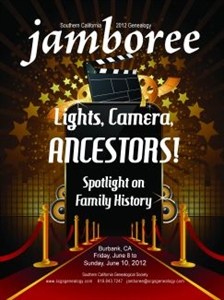
Picture of Southern California Genealogical Society Jamboree Conference 2012

Thursday, June 28, 2012

June 7-10, 2012
Part Two

By Dennis L. Maness, MLS


Friday Classes
A list can be found here if it hasn’t been taken down yet.

In the regular classes Friday afternoon Robert Raymond talked about Evidence Evaluation; he stated that “Not all information is created equal. We must take several factors into account to judge its quality.” “Evidence is something that furnishes proof,…information that is relevant to the problem and information that we conclude—after careful evaluation—supports or contradicts the statement we would like to make, or are about to make, about an ancestor.”

Steve Morse brought us up to date on the latest thing in DNA—Autosomal testing. And speaking of Steve and his One-Step page, I had lunch with Joel Weintraub, co-creator of the Census part of Steve’s site. He talked about how he and Steve are already working on tools for the 1950 census!

I visited both the Family Tree DNA table and the 23 and Me table to find out more about their autosomal DNA tests but I think $300 is just out of my league right now. Maybe when the cost goes down. I’m still in line for the $99 Ancestry.com test.

In his talk on “Lost in the Unknown: The Delicacy of Probing Family Secrets” Steve Luxenberg discussed problems when we’re doing those all-important oral interviews. How do you navigate the emotional pitfalls that surround the secrecy? How do you avoid alienating family members who might rather leave well enough alone?  Which interviewing styles tend to work, and which tend to go awry?


Saturday Classes
A list can be found here if it hasn’t been taken down yet.

At a breakfast on Saturday morning, Curt Witcher talked about “And the Rocket’s Red Glare: Online Resources for War of 1812 Research”. Although I’ve always liked it, Wikipedia has been looked down upon by many (most?) librarians but Curt actually recommended the Wikipedia War of 1812 article! It has more than 153 citations and many dozens of references at the end—a treasure trove for genealogists looking into their ancestors lives and service in this, the 200th Anniversary of the war.

Kory Meyerink held a class on “An Overview of Advanced Research Methods”. (I do wish speakers could think of more exciting titles, but I digress.) This was a fascinating look at how “advanced researchers use the same sources as all genealogists, they just use them differently. They must first change their thinking about how to approach research problems, learning how to deal with sources in new and different ways.”

I wanted to hear F. Warren Bittner talk about “Beat the Children With a Fresh Birch Stick So the Animals Don’t Get Worms: Reading for Historical Context” but the room was full! (See my remark about talk titles above.)

Instead of Bittner’s talk I got into D. Joshua Taylor’s “A Broader Context; Using JSTOR for Family History.” I may write about JSTOR in a future Digging For Roots Online column.

I heard Geoff Rasmussen talk about an “Insider’s Guide to Legacy Family Tree: Tips and Tricks.” And even though I’ve used Legacy for more than 10 years I still learned more about what I can do with it!

That night we attended the banquet “How Psychic Roots became an "Unsolved Mystery?" with Hank Z Jones, FASG. Hank shared “his adventures behind the NBC-TV dramatization of his ground-breaking bestseller (now in its 6th printing) and related even more amazing serendipitous experiences contributed by genealogists worldwide for his new sequel More Psychic Roots.”


Sunday Classes
A list can be found here if it hasn’t been taken down yet.

On Sunday I started the day at a breakfast where Rhonda McClure talked about “The Strange and Unexpected - Dealing with Research Surprises", a “light-hearted look at some of the unexpected surprises that fall out of the family tree when you least expect them.”

 I then went to a F. Warren Bittner talk (remember the “Beat the Children…” talk earlier?) with the admittedly non-exciting title “Complex Evidence: What Is It? How Does It Work? Why Does It Matter?” and found him to be a fascinating speaker who discussed Genealogical Proof Standard in a way which even I could understand with excellent examples from his own research.

Lisa B. Lee gave an interesting talk on “Speling Dusn’t Cownt and Why Wild Cards Are the Best Thing Since Sliced Bread”. But for once I actually knew as much about the subject as the speaker did! And was even able to disagree with her (silently, of course) about some of the things she said. But still she was a good speaker.

Perhaps one of the highlights of this conference was sitting and chatting in the evening, outside the classes, with genealogy superstars like Megan Smolenyak2, The Ancestry Insider, Ron Arons, Lisa Louise Cooke, Elyse Doerflinger, Thomas MacEntee, Steve Morse, and Randy Seaver (while my wife was in the hotel swimming pool with his wife Linda). They treated me just like a real fellow genealogist!

This was just a small sample of the kinds of subjects covered at a genealogy conference. If you’ve never been to a one I hope you will get the pleasure of experiencing one yourself someday.